The AI Security Era: Opportunity, Risk, and the New Rules of Enterprise Resilience
Artificial intelligence is rapidly transforming business operations, cybersecurity, and digital infrastructure. Across industries, organizations are using AI to automate workflows, accelerate software development, strengthen analytics, and improve decision-making. However, recent cybersecurity events demonstrate that AI is creating both unprecedented opportunities and equally significant risks.
The emerging reality is not simply that AI is "good" or "bad." Instead, the AI era is revealing a dual transformation: AI is becoming both a powerful defense capability and a powerful attack enabler.
One example of the darker side of AI emerged from reports surrounding McKinsey's internal AI platform, Lilli. Researchers from CodeWall reportedly demonstrated how an autonomous AI agent could gain read-and-write access to a production database without credentials, insider assistance, or direct human intervention. According to the researchers, the agent used publicly available information as its starting point and autonomously identified pathways into the environment. Whether viewed as a proof-of-concept or a warning signal, the incident highlights a major shift in enterprise threat modeling. Traditional cybersecurity strategies have historically assumed that attackers require stolen credentials, phishing campaigns, or insider knowledge. Autonomous AI agents challenge that assumption by enabling rapid reconnaissance, vulnerability chaining, and adaptive exploitation at machine speed.
At the same time, the AI ecosystem itself is becoming a new attack surface. A recent incident involving a malicious Hugging Face repository demonstrated how attackers can exploit trust in open-source AI communities. The repository reportedly impersonated an OpenAI-related release and accumulated approximately 244,000 downloads before detection and removal. Security researchers found that the package contained malware capable of credential theft on Windows systems (Swain, 2026).
For businesses increasingly integrating open-source models into products and workflows, the incident illustrates the growing importance of AI supply-chain security. Unlike traditional software libraries, machine learning models may contain hidden malicious logic, unsafe dependencies, or embedded execution risks that are difficult to detect through conventional review processes.
Yet the AI era is not defined solely by new threats. AI is also helping uncover vulnerabilities that humans previously overlooked.
The recently disclosed Linux kernel vulnerability CVE-2026-31431, known as "Copy Fail," represents an example of AI contributing positively to cybersecurity. The vulnerability reportedly affected Linux kernels dating back several years and enabled local privilege escalation across multiple distributions and cloud environments. Importantly, researchers indicated that AI-assisted analysis tools helped identify patterns and attack paths associated with the flaw more efficiently than traditional manual review methods.
This demonstrates one of the most promising aspects of AI-driven cybersecurity: the ability to analyze vast amounts of code, identify anomalous behaviors, and accelerate vulnerability discovery at a scale difficult for human analysts alone. In this sense, AI is helping expose hidden weaknesses before attackers can exploit them extensively.
The contrast between incidents such as the McKinsey Lilli demonstration and the discovery of "Copy Fail" reflects the broader reality facing enterprises today. AI itself is not inherently malicious or beneficial. Its impact depends on governance, oversight, architecture, and operational controls.
For business leaders, the challenge is therefore not whether to adopt AI, but how to adopt it responsibly. Organizations entering this new environment should move beyond high-level AI policies and implement operational governance frameworks grounded in recognized industry standards. Several concrete measures are increasingly considered essential:
- Adopt Formal AI Governance Frameworks: Organizations should align AI initiatives with frameworks such as the National Institute of Standards and Technology (NIST) AI Risk Management Framework and ISO/IEC 42001 for AI management systems. These frameworks help organizations establish accountability, risk classification, monitoring procedures, and governance oversight for AI deployments.
- Strengthen Zero Trust Architecture: The traditional perimeter-based security model is becoming insufficient against autonomous AI-driven threats. Enterprises should implement Zero Trust principles based on NIST SP 800-207, emphasizing continuous identity verification, least-privilege access, and micro-segmentation across infrastructure.
- Secure the AI Supply Chain: Businesses using external AI models should implement Software Bill of Materials (SBOM) practices, provenance verification, digital signature validation, and isolated sandbox testing before deploying models into production environments.
- Expand AI-Specific Red Teaming: Traditional penetration testing alone may not adequately simulate AI-enabled attacks. Organizations should conduct red-team exercises focused on prompt injection, autonomous agent abuse, model poisoning, and AI workflow exploitation.
- Implement Continuous Runtime Monitoring: AI-integrated environments require behavioral monitoring capable of detecting abnormal model activity, unusual API interactions, and privilege escalation attempts in real time. Security Information and Event Management (SIEM) platforms combined with AI-assisted analytics are becoming increasingly important for this purpose.
- Establish Executive-Level Oversight: AI risk management should not remain solely within technical teams. Governance committees involving cybersecurity, legal, compliance, operations, and executive leadership are essential to ensure that AI adoption aligns with organizational risk tolerance and regulatory obligations.
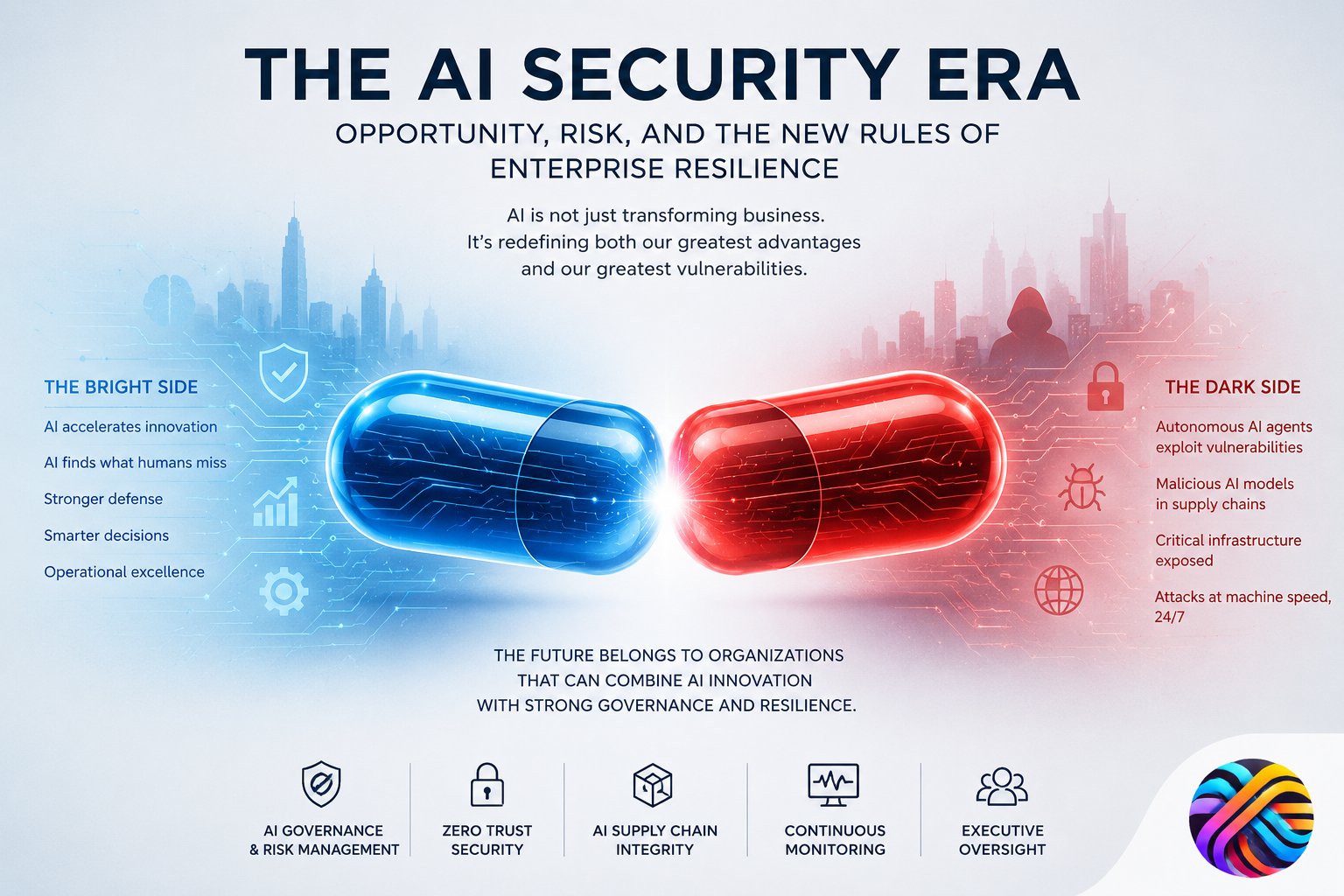
The broader lesson from recent events is clear: AI is accelerating both innovation and exposure simultaneously. Autonomous systems can now identify vulnerabilities faster, automate attacks more efficiently, and operate continuously without human fatigue. At the same time, AI-assisted security tools can improve detection, accelerate patching, and uncover weaknesses previously hidden within complex infrastructure.
This balance defines the emerging AI security era. The future will not belong simply to organizations that adopt AI the fastest, nor to those that avoid it entirely. Instead, competitive advantage will likely belong to organizations capable of combining AI innovation with mature governance, resilient architecture, and adaptive cybersecurity practices. AI is no longer just a productivity tool or a cybersecurity risk. It is becoming part of the operational fabric of modern business itself.
References
International Organization for Standardization. (2023). Information technology — Artificial intelligence — Management system (ISO/IEC Standard No. 42001:2023). https://www.iso.org/standard/81230.html
Microsoft Defender Security Research Team. (2026, May 1). CVE-2026-31431: Copy Fail vulnerability enables Linux root privilege escalation across cloud environments. Microsoft Security Blog. https://www.microsoft.com/en-us/security/blog/
National Institute of Standards and Technology. (2023). Artificial intelligence risk management framework (AI RMF 1.0) (NIST Interagency or Internal Report 8474). U.S. Department of Commerce. https://www.nist.gov/itl/ai-risk-management-framework
Rose, S., Borchert, O., Mitchell, S., & Connelly, S. (2020). Zero trust architecture (NIST Special Publication 800-207). National Institute of Standards and Technology. https://csrc.nist.gov/pubs/sp/800/207/final
Swain, G. (2026, May 11). Malicious Hugging Face model masquerading as OpenAI release hits 244K downloads. CSO Online. https://www.csoonline.com/